


No workers
Zero infrastructure to deploy
Inngest calls your existing HTTP server – no worker processes, no queue confir, no ops surface to maintain.
If you're evaluating Temporal alternatives, Inngest vs Temporal is just a question about whether you want to spend more time on code, or the infrastructure around it. Inngest lets you ship faster, no matter how your code is written or where it lives.
Developers on UX, DX, and why they switched from hand-rolled queues or Temporal-style orchestration.
 yo puaaaPostHog
“The UX/UI difference between Inngest and Temporal is night and day.”
 Claire VoProduct leader
“Using Inngest is like a little gift to myself.”
“I've constantly felt like I'm losing my mind because there are a lot of Temporal stans and I have often felt it wasn't it DX wise. Going to try out Inngest soon.”
Zero infrastructure to deploy
Inngest calls your existing HTTP server – no worker processes, no queue confir, no ops surface to maintain.
Built for how agents actually fail
Step memoization, human-in-the-loop, and per-LLM-call observability – first-class, not bolted on.
TypeScript, Python, Go – or anything with HTTP
Temporal’s strongest SDK is Go, Inngest treats every language as a first-class citizen.
Temporal requires workers as a deployment unit. Temporal puts a server, a database, and worker processes in your cloud before you write a line of business logic.
export async function getUser(userId: string) {
  const user = await db.getUser(userId);
  if (!user) {
    throw InvalidAccountError('User not found');
  }
  return user;
}
export async function sendWelcomeEmail(email: string) {
  // ...
}
export async function startTrial(userId: string) {
  // ...
}
import { proxyActivities } from '@temporalio/workflow';
import { ApplicationFailure } from '@temporalio/common';

export async function welcomeWorkflow(
  userSignup: { id: string }
) {
  const {
    getUser,
    sendWelcomeEmail,
    startTrial
  } = proxyActivities<typeof activities>({
    retry: {
      initialInterval: '1 second',
      maximumInterval: '1 minute',
      backoffCoefficient: 2,
      maximumAttempts: 4,
      nonRetryableErrorTypes: ['InvalidAccountError'],
    },
    startToCloseTimeout: '1 minute',
  });

  const user = await getUser(userSignup.id);

  await sendWelcomeEmail(user.email);

  try {
    await startTrial(user.id);
  } catch (e) {
    throw ApplicationFailure.create({
      message: 'Failed to start trial'
    });
  }

  return 'Workflow complete';
}
import { Worker } from '@temporalio/worker';
import * as activities from './activities';
import { namespace, taskQueueName } from './shared';

async function run() {
  // Workflows are loaded from the workflowsPath
  // which modifies the code at runtime
  const worker = await Worker.create({
    workflowsPath: require.resolve('./workflows'),
    activities,
    namespace: 'acme-app',
    taskQueue: 'user-workflows',
  });

  await worker.run();
}

run().catch((err) => {
  console.error(err);
  process.exit(1);
});
Inngest calls your existing HTTP endpoints – no new infrastructure, no separate deployment pipeline.
import { Inngest, NonRetriableError } from 'inngest';

export const inngest = new Inngest({
  id: 'acme-app',
});

export const welcomeWorkflow = inngest.createFunction(
  { id: 'welcome-workflow', retries: 4 },
  { event: 'user.signup'},
  async ({ event, step }) => {
    const user = await step.run('get-user', async () => {
      const user = await db.getUser(userId);
      if (!user) {
        throw NonRetriableError('User not found');
      }
      return user;
    });

    await step.run('send-welcome-email', async () => {
      await sendWelcomeEmail(user.email);
    });

    await step.run('start-trial', async () => {
      await startTrial(user.id);
    });

    return 'Workflow complete';
  }
)
import { serve } from 'inngest/express';
import { inngest, welcomeWorkflow } from './workflows';

app.use('/api/inngest', serve({
  client: inngest,
  functions: [welcomeWorkflow]
}));

app.listen(3000);
Time to first execution
Hours to days – provision workers, server, and database first
Minutes – npx inngest-cli@latest dev and wrap an existing function
Multi-step execution
Workflows + Activities – their terms for functions & steps
step.run() – plain async, automatic persistence (Temporal calls these Activities)
Fan-out / Parallel Steps
Parallel activity execution
promise.all over step.run()
Scheduled / Cron
Cron schedules
Native cron trigger (Temporal: Schedules)
SDK ergonomics
Determinism rules add cognitive hoverhead; Go SKD most mature
Plain async/await — no determinism constraints
Language support
Go, Java, TypeScript, Python – Go SKD significantly ahead; Java unique to Temporal
TypeScript, Python, Go — any HTTP runtime
Step memoization
Activity results are cached, but retries re-run the whole activity
Completed steps never re-run on retry
Human-in-the-loop
Signals — Temporal’s term for what Inngest calls waitForEvent
step.waitForEvent() — native primitive (Temporal calls these Signals)
Durable HTTP endpoints
Not supported
Durability for real-time / streaming agent calls
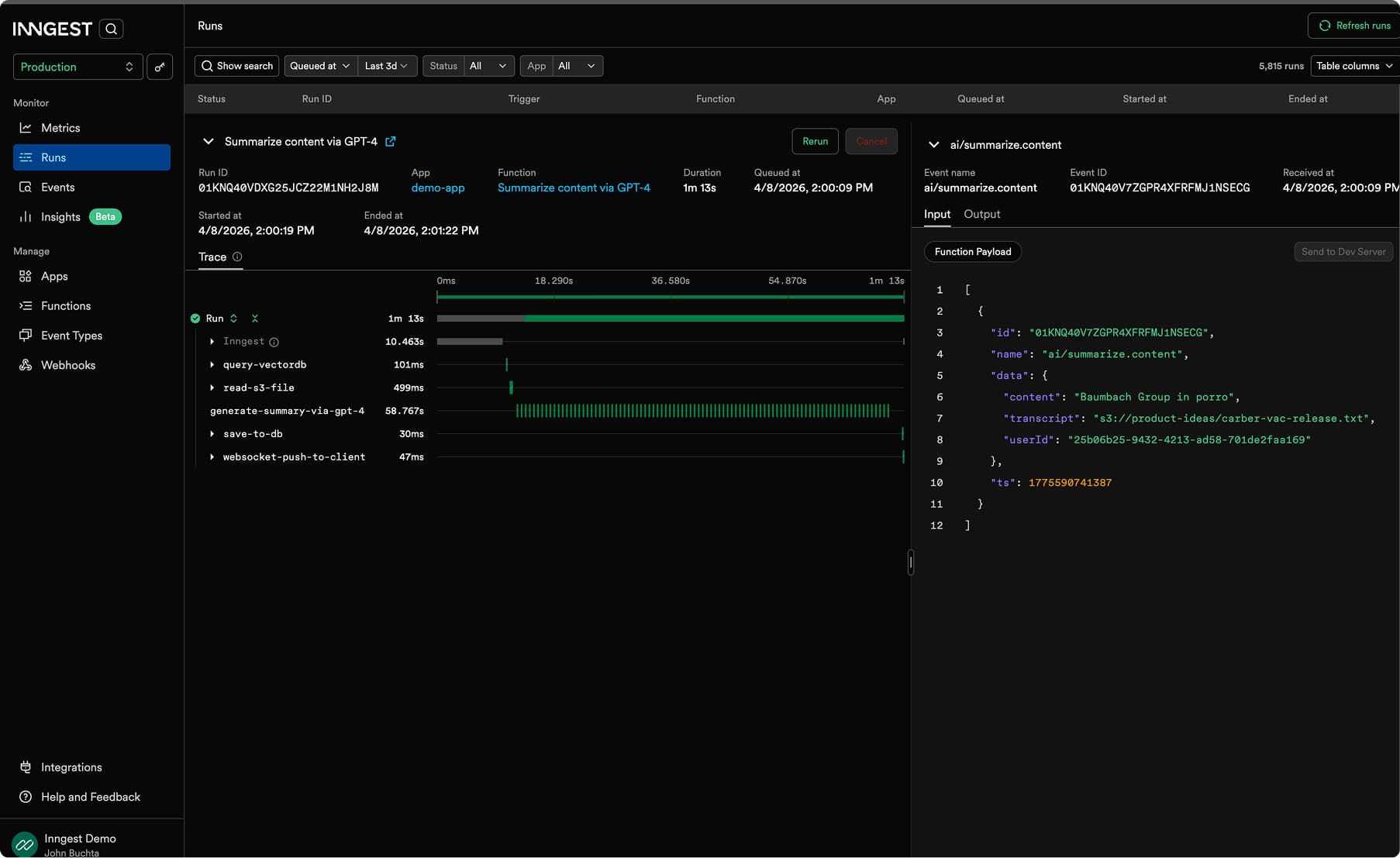
Step-level traces
Event History (Temporal’s term) — workflow-level, less granular per step
Every step timed and inspectable in the dashboard
Queue delay vs. execution time
Not broken out natively — custom instrumentation needed
Surfaced separately per run
Bulk replay
Workflow reset (Temporal’s term) — per-workflow via CLI, no bulk UI
Re-run failed functions in bulk from the dashboard
Per-key concurrency
Task queues — Temporal’s term; sized at worker level, not per-key
One line of function config
Rate limiting
No built-in rate limiting — requires custom implementation
Built-in, per function or per user
Debouncing
No native debouncing — achievable with custom signal/timer logic
Native
Temporal was architected for deterministic workflows.
The primitives it exposes reflect that – and so do the gaps.
const summary = awaitstep.run('summarize', async () => {return llm.complete(transcript) })// On retry, this step is skipped.// The LLM is not called again.
Connect to your existing codebase. No credit card, no workers, no infrastructure to provision.
No credit card • Instant access • Free Tier
Migration support, custom SLAs, SS, HIPPA BAA, and a solution scoped to your architecture.



Usually responds within 1 business day
Yes. Inngest is a Temporal alternative built for teams that want durable execution without running workers, a cluster, or a separate queue. You write normal async functions, wrap side effects in step.run(), and Inngest invokes your existing HTTP app. Among Temporal competitors, Inngest is the option that keeps your current deployment as the runtime instead of asking you to operate a new one.
The core Inngest vs Temporal difference is architecture. Temporal requires workers that poll a cluster, either self-hosted or on Temporal Cloud. Inngest has no workers: it calls your existing deployment over HTTP. Temporal workflow code must be deterministic because it replays history. Inngest uses step memoization, so non-deterministic LLM calls do not need a separate Activity layer. Inngest also ships native rate limiting, per-key concurrency, and step-level traces that Temporal typically requires you to build.
Inngest orchestrates AI workflows by invoking your functions via HTTP between steps. You write workflows as normal async functions and wrap logic in step.run(). Inngest handles retry logic, state, and scheduling between steps — no extra queues, workers, or stateful backends required.
Quick-start guideNo. This is a common misconception based on how easy Inngest is to get started with. Ease of setup is a product decision, not a capacity ceiling. Inngest runs production workloads at companies processing millions of events daily. Small teams ship faster with it. Large teams don't outgrow it.
Partially. Temporal Cloud removes the need to self-host the Temporal cluster, but you still run and manage your own worker fleet — the processes that pull and execute your workflows. With Inngest, there are no workers to run at all. Your existing deployment is the worker. Inngest invokes your functions via HTTP.
Yes. Inngest is open-source and can be self-hosted. The cloud product adds managed infrastructure, observability, and reliability on top — but the core engine is yours to run.
Temporal has been around longer and targets a different audience — large engineering teams with dedicated platform engineers who can manage distributed worker infrastructure. Inngest is newer and optimized for teams who want durable execution without that operational overhead. Stars reflect history and audience, not fit for your use case.
Yes. The core concepts map directly: Temporal Workflows become Inngest functions, Activities become step.run() calls. The main shift is architectural — you stop running workers and let Inngest invoke your existing deployment instead. Most teams migrate incrementally, running both in parallel during the transition.
Temporal Cloud starts at $100/month plus the cost of running your own worker fleet — compute, scaling, and maintenance. Inngest starts at $99/month with no workers to run. At scale, the more meaningful difference is operational cost: Inngest removes an entire infrastructure layer that Temporal requires you to manage.
Temporal's execution model requires workflow code to be strictly deterministic — it replays history to reconstruct state after failures. LLMs are inherently non-deterministic, which means you have to carefully isolate every model call inside an Activity to prevent replay errors. Inngest was architected around steps from the start, with no determinism requirement on the orchestration layer. Every LLM call is naturally a step. There's no replay model to design around, no risk of non-deterministic code causing execution failures, and no mental overhead separating "workflow code" from "activity code." For AI, that's a meaningful difference.
No workers to deploy. No queues to configure.
Connect Inngest to your existing codebase and ship your first durable function today.
No credit card required · Free tier · Deploy in minutes